

Node.js Security Updates: Preparing for November 11
Published:
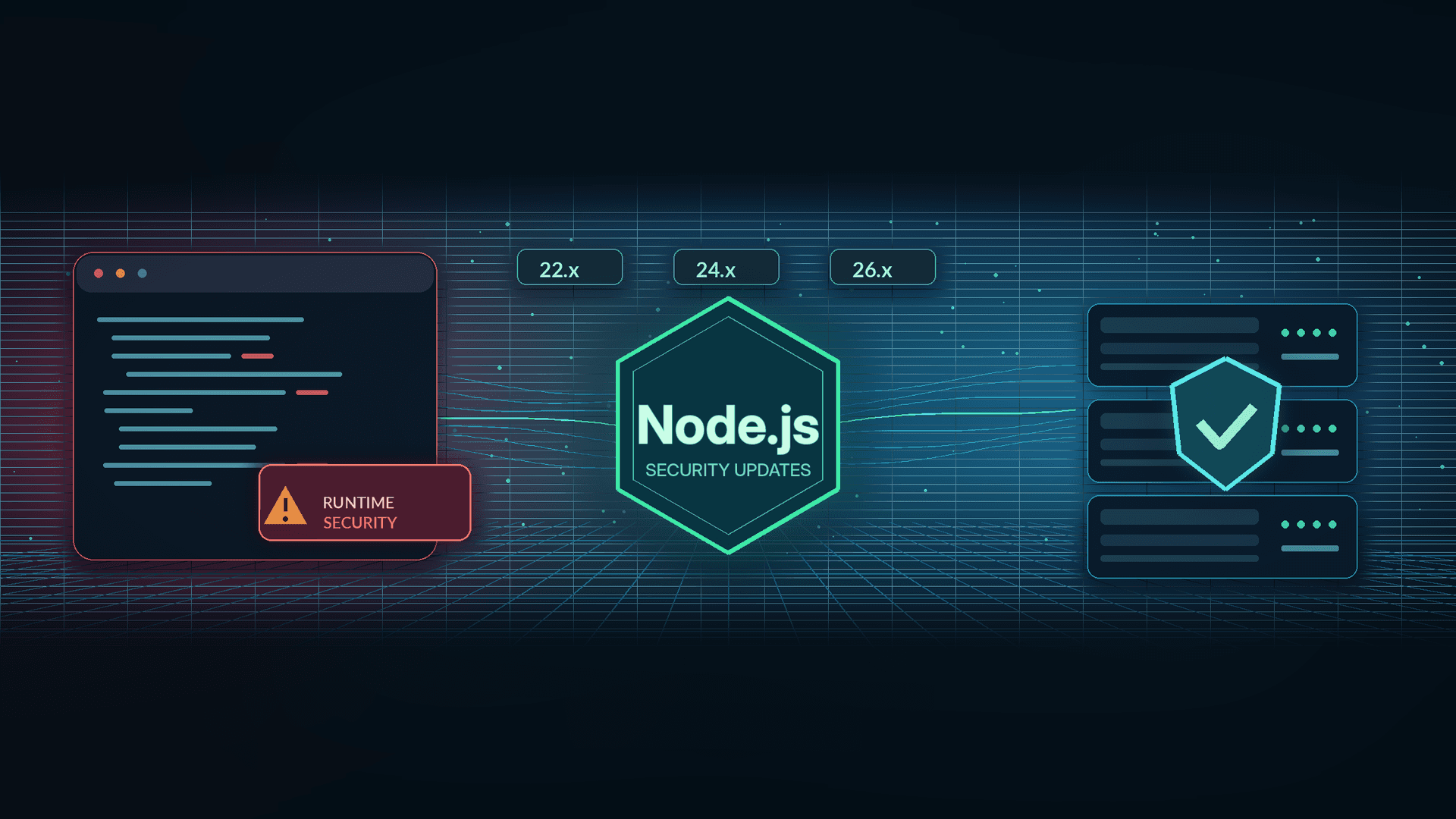
On November 3, 2026, the Node.js project announced that it plans to publish security updates on or shortly after Wednesday, November 11. The updates will cover the Node.js 22.x, 24.x, and 26.x release lines. The highest severity of the issues scheduled to be fixed is High for each line.
The official notice does not yet identify the vulnerabilities, give their CVE numbers, or say how many issues are involved. It also does not name the forthcoming patched versions. This is an advance warning, not a completed security release. Claims about a particular November exploit or an already available November patch would be premature.
Which Node.js Versions Are Covered?
The planned updates apply to Node.js 22, 24, and 26. According to the official release schedule, all three are supported LTS release lines. Node.js recommends supported LTS releases for production applications.
Node.js 20 and 25 have reached end of life. They no longer receive security updates from the Node.js project. Being absent from the patch announcement does not make an older release safe. Teams still running an unsupported version should plan a move to a supported LTS release.
It is too early to conclude that every Node.js application is exposed to the same attack. The affected components and conditions will become clearer when the security releases and their technical advisories are published.
These Are Not the October Node.js Vulnerabilities
Node.js issued a separate set of security updates on October 21, 2026. One of the issues, CVE-2026-111497, affected the bundled Brotli decompression component. Under certain conditions, malformed compressed input could corrupt memory and potentially lead to remote code execution.
That October issue was fixed in Node.js 22.23.4, 24.22.1, and 26.12.1. The October security advisory documents it alongside the other vulnerabilities addressed in that release.
Those version numbers are not the November fixes. No patched version numbers have been published for the November announcement. Systems missing October's updates still need those existing patches, while teams should separately watch for November's releases.
Why Should Businesses Prepare Now?
Node.js is used beyond developers' laptops. It can run a company's APIs, customer-facing portals, and background services. Different applications within the same business may also depend on different Node.js versions.
Updating application code does not necessarily update the Node.js runtime. A new deployment can continue using an older Node.js container image. Build agents and test environments may use different versions again.
A useful first step is to identify where Node.js runs and which versions are installed. In the relevant runtime environment, the version can be checked with:
node --version
For containerized applications, check inside the running container rather than relying only on the host machine. Include the Node.js versions used by CI/CD pipelines in the same inventory.
What Should Happen When the Updates Arrive?
Once the November releases are available, review the Node.js security announcement for affected components and fixed versions. That is when the required upgrades can be identified accurately.
Test the relevant runtime upgrades before rolling them into production. Run automated tests, check important application workflows, and prepare a rollback plan. If your application runs in containers, rebuild and deploy an image that actually includes the patched Node.js runtime.
Running npm audit is not a substitute for updating Node.js. The command checks npm package dependencies for known vulnerabilities. A vulnerability in the Node.js runtime must be addressed by updating that runtime separately.
There is no confirmed November patch version to install as of November 5. For now, the useful work is to inventory versions, confirm that October's fixes have been applied where needed, and prepare the test and deployment process.
How Intellego Can Help Maintain Your Node.js Infrastructure
At Intellego Softworks, we develop web applications, set up server infrastructure, and maintain deployed systems. Our DevOps services include CI/CD pipelines, container environments, testing workflows, and application monitoring.
For applications running on Node.js, we can help identify runtime versions across services and deployment environments, test upgrades, and roll out changes in a controlled way. If an older application depends on an unsupported release, we can assess compatibility issues and plan a staged migration.
To review your Node.js services and update process, contact Intellego Softworks.
Questions and answers
- Have the November 2026 Node.js CVE identifiers been published?
- No. As of November 5, 2026, the Node.js team has announced upcoming fixes for High-severity issues but has not released individual CVE identifiers or technical details.
- Will Node.js 20 receive these security updates?
- Node.js 20 is end-of-life and no longer receives new security releases from the project. Applications that still use it should be assessed for migration to a supported LTS version.
- Is updating npm dependencies enough?
- No. npm dependencies and the Node.js runtime are separate parts of the software environment. Both need to be tracked and maintained.
Sources
- Node.js - November 2026 Security Release Pre-Alert
- Node.js - Previous Releases and Support Status
- Node.js - End-of-Life Releases
- Node.js - October 2026 Security Releases
- Openwall oss-security - Node.js Security Pre-Alert (November 4, 2026)
- Cyber Security News - Node.js Schedules High-Severity Security Fixes
- npm Documentation - npm audit